
By Dr. Zahid H. Bukhari, Updated: October 18, 2026
The Missing Question
Federal statistics describe nearly every measurable feature of American life except one: religion. The decennial census and the annual American Community Survey report on age, sex, race, Hispanic origin, ancestry, language, education, occupation, income, marital status, veteran status, place of birth, citizenship and housing. The Bureau’s economic censuses describe businesses and industries in similar detail.
These variables matter because they help explain human behavior. While we ask about almost all of them, the “R” question is conspicuously absent. The omission is deliberate: the Census Bureau says federal law bars it from asking about religious affiliation on a mandatory basis, so it does not collect religion data at all [1][2].
Several other developed countries, including the United Kingdom, Canada and Australia, do ask about religion in their censuses. In the United Kingdom and Australia the question is explicitly voluntary, a point that matters for the American debate.
Why religion matters
The influence of religion on individual social and political behavior has become a major field of study. For much of the twentieth century, many social scientists predicted that religion’s role would fade as societies modernized. Events have not borne that prediction out, at home or abroad.
Elections show how closely religion tracks political choices. In Pew Research Center’s study of validated 2024 voters, 81% of White evangelical Protestants and 55% of Catholics voted for Donald Trump, while 70% of religiously unaffiliated voters backed Kamala Harris. Voters who attend services at least monthly favored Trump 64% to 34% [3]. The pattern persists: in an October 2026 survey of registered voters, 73% of White evangelicals preferred Republican House candidates, while 74% of Black Protestants and 61% of the unaffiliated preferred Democrats [4].
Religious institutions also carry a large share of the nation’s family support, community development and social services, from food pantries and shelters to schools, hospitals and refugee resettlement. Planning that work well requires knowing where communities live and how they are changing.
How religion left the census
The first U.S. census, taken in 1790, counted 3.9 million inhabitants and asked about little beyond household size. Religion entered later, and only through institutions. From 1850 through 1890, census takers asked clergy about their congregations, buildings, seating capacity and property; the 1850 count found 38,183 congregations [5]. Individuals were never asked about their own faith.
In 1906 this work became a separate Census of Religious Bodies, taken every ten years from questionnaires mailed to denominational leaders. The 1936 edition was the last one published. Data were collected in 1946, but Congress never funded their tabulation, and by 1956 it had ended the program altogether [6]. Opposition came from several directions, including Christian Scientists, some Baptist groups and the Church of Jesus Christ of Latter-day Saints [5].
In 1956 the Bureau announced it was considering a religion question for the 1960 census. Its director, Robert W. Burgess, argued the question was no more intrusive than asking about education [5]. The Bureau tested a voluntary question on 431 Milwaukee households in November 1956, then on the Current Population Survey in March 1957: “What is your religion? Baptist, Lutheran, etc.” About 35,000 households responded, and 96% of people aged 14 and older reported a religion [5][7]. Two-thirds identified as Protestant, about a quarter as Catholic and a little over 3% as Jewish, while 2.7% reported no religion; the chart below compares these results with today’s [5].
The announcement set off a vigorous national debate. Jewish organizations, still conscious of the Holocaust, publicly cited the separation of church and state and privately feared that official statistics linking religion to income and education could fuel antisemitism [8]. Facing this opposition, the Bureau dropped the question in late 1957 and released only a short summary of the survey results [5][6]. It declined again before the 1970 census, citing the separation of church and state [6].
In April 1976, Director Vincent P. Barabba announced there would be no religion question in 1980, because a question on a census where replies are mandatory would appear to infringe on that separation [5]. Six months later, the 94th Congress amended Title 13 of the U.S. Code. The same law that authorized a mid-decade census added this sentence: “Notwithstanding any other provision of this title, no person shall be compelled to disclose information relative to his religious beliefs or to membership in a religious body” [2][9].
The wording matters. The statute bars compulsion, not the question itself. The Bureau may ask about religion on a voluntary basis in its surveys, but it has chosen not to ask about religious identity, touching the subject only indirectly, as when one survey asked how often children attended religious services [5][6]. The result is that federal data cover nearly every aspect ofAmerican life except religion.
A changed landscape
When the Bureau tested its question in early 1957, the U.S. population was about 170 million. The Census Bureau now estimates it at 341.8 million as of July 1, 2025 [10]. The country’s religious makeup has changed even more than its size.
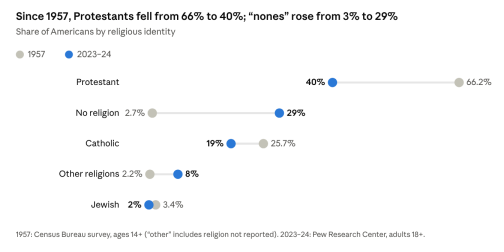
1957: Current Population Survey results as published in the original article and Census Bureau report P-20 No. 79 [7] · 2023–24: Pew Religious Landscape Study [11]
Pew Research Center’s 2023–24 Religious Landscape Study, its third since 2007, documents four shifts [11][12]:
1. Non-Christian faiths are a larger presence. Seven percent of adults belong to religions other than Christianity; among immigrants the figure is 14%, including 4% Muslim, 4% Hindu and 3% Buddhist [11].
2. Mixed-religion households are common. Twenty-six percent of married adults have a spouse of a different religion, as do 38% of unmarried adults living with a partner [12].
3. Denominational composition is shifting. Since 2007, evangelical Protestants fell from 26% to 23% of adults, mainline Protestants from 18% to 11%, and historically Black Protestant churches from 7% to 5%, while nondenominational Protestantism grew [11].
4. The unaffiliated have grown. Twenty-nine percent of adults now identify as atheist, agnostic or “nothing in particular,” up from 16% in 2007, though the share has leveled off, at least for now [11][13].
Competing estimates
Private surveys have filled much of the gap, but without an official benchmark their numbers often disagree by millions of people. When this article first appeared, a Baylor University study put evangelicals at 33.6% of the population and the University ofAkron’s Bliss Institute at 26.3%, a difference of about 21 million people. The disagreements persist, largely because each organization defines and asks about religious identity differently.
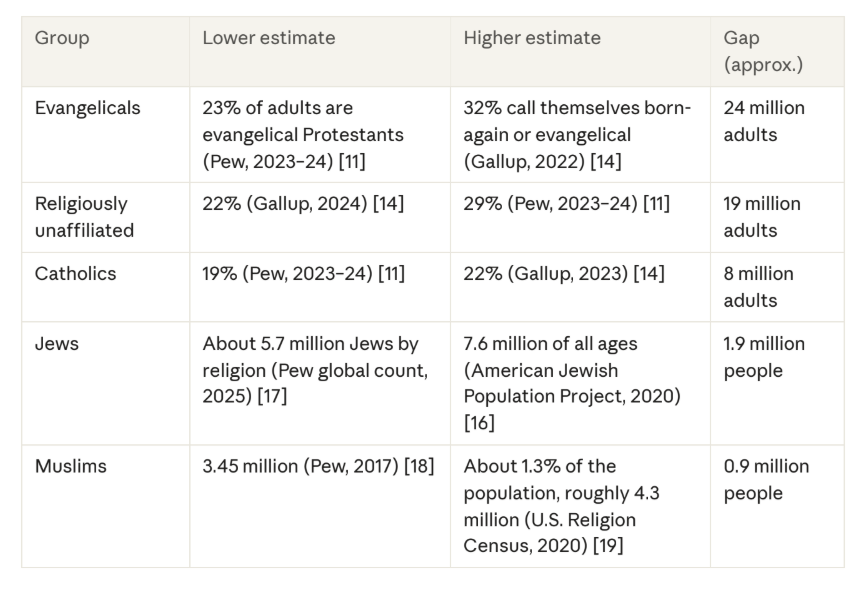
Gaps in adults assume about 270 million U.S. adults [10]. PRRI’s 2024 estimate of the unaffiliated, 28%, is close to Pew’s [15], which shows that a single figure can be well supported and still disputed.
The Hispanic population, now 20.5% ofAmericans and larger than the Black population (13.5%) [10], illustrates what is at stake. Pew found that 43% of Hispanic adults identified as Catholic in 2022, down from 67% in 2010, while 30% were unaffiliated [20]. National surveys can track such trends, but their samples are too small to say much about most counties, cities or congregations.
The Jewish population has long been the subject of methodological dispute. The $6 million National Jewish Population Survey of 2000–01, sponsored by United Jewish Communities, reported a drop of 400,000 within a decade, from 5.8 million to 5.2 million. Scholars questioned its methods at a colloquium at Brandeis University, and some urged that the decennial census ask about religion. Two decades later the count still turns on definition: Pew estimated 7.5 million Jews of all ages in 2020, but its 2025 global study, counting only Jews by religion, left out about 1.8 million people who are Jewish by culture or family background [16][17].
Estimates of the Muslim population have been just as contested. In 1989 the New York Times put it at 6 million. In 2001, Tom Smith of the University of Chicago, in a study for the American Jewish Committee, estimated 1.9 million and argued that the population was commonly overstated several times over; other scholars rejected that figure in favor of 6 to 8 million. Pew’s estimate for 2017 was 3.45 million, or 1.1% of the population, growing by roughly 100,000 a year [18]. The 2020 U.S. Religion Census, which counts through congregations, put Muslims at about 1.3% of the population [19].
The unaffiliated were estimated at 10% to 14% ofAmericans when this article was first written. The question today is not whether the group has grown but how large it is, and reputable surveys differ by seven points.
What other countries do
Many countries do what the United States will not: more than a third of the world’s countries have included religion in recent censuses, some as a required question and some as an optional one [5].
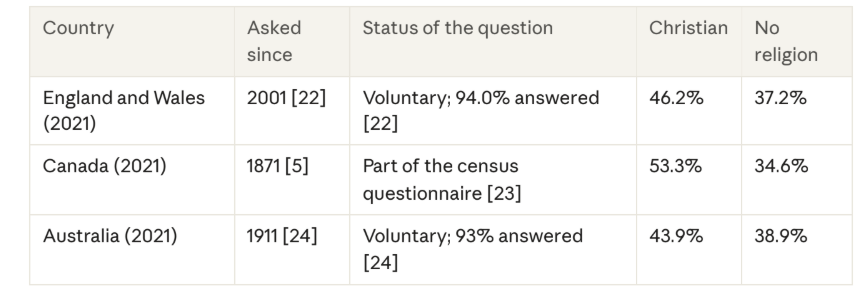
These censuses show that a voluntary question can still produce near-universal data. Australia took its next census on August 11, 2026, keeping the religion question optional under its statistics law [25]. Its statistics bureau had considered rewording the question after complaints that it assumed respondents had a religion, then kept the original wording; religion results are expected around June 2027 [26]. That debate carries its own lesson: wording shapes results, which is one reason a consistent official question is so valuable.
The objections, and answers to them
The objections raised in the 1950s and 1970s deserve a serious answer, because they have not gone away. Critics argue that a government question about faith strains the separation of church and state, that it could deter people from returning their forms, and that official counts of religious groups could be misused [5].
The fear of misuse has a real history. After the Second War Powers Act of 1942 suspended census confidentiality, the Bureau supplied neighborhood data that helped locate Japanese Americans for internment, and in 1943 it gave the Secret Service the names and addresses of Japanese Americans in the Washington, D.C., area; Congress restored confidentiality in 1947 [27]. In 2003 and 2004, the Bureau gave the Department of Homeland Security ZIP-code tabulations of people who reported Arab ancestry in the 2000 census, prompting protests from civil liberties groups and new Bureau procedures for sensitive data [28]. American Muslims and other religious minorities have every reason to weigh these episodes.
These concerns argue for strong safeguards, not for continued ignorance:
- Keep the question voluntary. Title 13 already forbids compelling an answer [2], and voluntary questions in England and Wales and in Australia are answered by more than 90% of residents [22][24].
- Ask about affiliation, not belief. A question on religious identity, like the one tested in 1957, does not probe doctrine or practice.
- Rely on, and strengthen, confidentiality law. Census Bureau staff face up to five years in prison and a $250,000 fine for disclosing personal information, and individual census records stay sealed for 72 years [29].
- Publish only statistical summaries, protect small groups from identification, and bar special tabulations of religious groups for law enforcement or security agencies.
A voluntary question endorses no faith. It simply allows Americans who wish to be counted to be counted.
A path to better data
Census data on religion would not resolve every question. But students, scholars, journalists and policymakers would finally have reliable numbers to report and analyze. Religious communities could plan places of worship, schools, businesses, and health, social service and community development programs from real data rather than competing estimates.
Part of the work is already being done privately. The 2020 U.S. Religion Census, compiled by the Association of Statisticians ofAmerican Religious Bodies, counted 356,642 congregations belonging to 372 religious bodies, with 161 million adherents, or 48.6% of the population [21]. The Census Bureau still publishes county-level economic data on religious organizations [5]. What is missing is a count of individuals: the affiliated, the unaffiliated and everyone in between.
What we need is a comprehensive picture of religion in America, covering religious preference and non-affiliation, religious bodies, places of worship, and faith-based educational, health and social service institutions. Three steps would get us there:
1. Test first. The Bureau may already ask a voluntary religion question in its non mandatory household surveys [5][6]. It should do so, as it did in 1957, and this time publish the results in full.
2. Plan for 2030. By law the Bureau must report the subjects of the 2030 census to Congress byApril 1, 2027, and the actual questions byApril 1, 2028 [30][31]. A voluntary question on religious affiliation belongs on that list. 3. Restore the institutional count. Congress should fund the Bureau to work with religious bodies again, as it did in the Census of Religious Bodies, building on the private U.S. Religion Census.
Congress should act now, while the 2030 census is still being designed.
Dr. Zahid Bukhari is the former Project Director of the American Muslim Studies Program at the Prince Alwaleed Bin Talal Center for Muslim-Christian Understanding, Georgetown University. An earlier version of this article was published by the center [32].
References
1. U.S. Census Bureau. “Religion.” census.gov, archived page, last revised October 1, 2004.
2. 13 U.S.C. § 221, Refusal or neglect to answer questions; false answers. Legal Information Institute, Cornell Law School.
3. Hartig, H., S. Keeter, A. Daniller and T. Van Green. “Voting Patterns in the 2024 Election.” In Behind Trump’s 2024 Victory, a More Racially and Ethnically Diverse Voter Coalition. Pew Research Center, June 26, 2025.
4. Smith, G. A. “Religious Groups Differ Widely in Their 2026 Midterm Preferences.” Pew Research Center, October 13, 2026.
5. Diamant, J., and R. Leppert. “Why the U.S. Census Doesn’t Ask Americans About Their Religion.” Pew Research Center, April 12, 2023.
6. Rosen, A. F. “A Brief History of Religion and the U.S. Census.” Pew Forum on Religion & Public Life, 2008; republished January 26, 2010.
7. U.S. Bureau of the Census. “Religion Reported by the Civilian Population of the United States: March 1957.” Current Population Reports, Series P-20, No. 79, February 2, 1958 (catalog record).
8. Schultz, K. M. “Religion as Identity in Postwar America: The Last Serious Attempt to Put a Question on Religion in the United States Census.” Journal of American History 93, no. 2 (September 2006).
9. Public Law 94-521, 90 Stat. 2459 (amending Title 13, U.S. Code), October 17, 1976.
10. U.S. Census Bureau. “QuickFacts: United States.” Vintage 2025 population estimates.
11. Smith, G. A., A. Cooperman, B. A. Alper, B. Mohamed, C. Rotolo, P. Tevington, J. Nortey, A. Kallo, J. Diamant and D. Fahmy. “Decline of Christianity in the U.S. Has Slowed, May Have Leveled Off” (2023–24 Religious Landscape Study), executive summary. Pew Research Center, February 26, 2025.
12. Pew Research Center. “Religious Intermarriage.” Chapter 4 of the 2023–24 Religious Landscape Study, February 26, 2025.
13. Pew Forum on Religion & Public Life. “The Religious Composition of the United States.” Chapter 1 of the U.S. Religious Landscape Survey, February 2008.
14. Gallup. “Religion” (historical trends). Accessed October 2026.
15. PRRI. “2024 PRRI Census of American Religion.”
16. Pew Research Center. “The Size of the U.S. Jewish Population.” In Jewish Americans in 2020, May 11, 2021.
17. Jewish Telegraphic Agency. “How Many American Jews Are There? A Global Study of World Religions Offers a New Estimate.” June 9, 2025.
18. Mohamed, B. “New Estimates Show U.S. Muslim Population Continues to Grow.” Pew Research Center, January 3, 2018.
19. Religion News Service. “Religious Groups With Immigrant Members Grew Fastest Over Past Decade.” November 11, 2022.
20. Pew Research Center. “Among U.S. Latinos, Catholicism Continues to Decline but Is Still the Largest Faith.” April 13, 2023.
21. Association of Religion Data Archives. “U.S. Religion Census: Information on Data Sources.” Data from the 2020 U.S. Religion Census, Association of Statisticians of American Religious Bodies.
22. Office for National Statistics. “Religion, England and Wales: Census 2021.” November 29, 2022.
23. Statistics Canada. “Canada at a Glance, 2023: Immigration and Ethnocultural Diversity.”
24. Australian Bureau of Statistics. “2021 Census Shows Changes in Australia’s Religious Diversity.” Media release, June 2022.
25. AAP FactCheck. “Falsehoods Spread About Census ‘Christian’ Category.” August 11, 2026.
26. Uniting Church in Australia, Insights. “What Tonight’s Census Won’t Tell You About Faith in Australia.” August 2026.
27. Scientific American. “Confirmed: The U.S. Census Bureau Gave Up Names of Japanese Americans in WW II.” 2007.
28. Electronic Privacy Information Center. “Department of Homeland Security Obtained Data on Arab Americans From Census Bureau.” 2004.
29. U.S. Census Bureau. “The 2020 Census and Confidentiality.” Fact sheet (copy hosted by the Illinois State Board of Education).
30. 13 U.S.C. § 141, Population and other census information. FindLaw.
31. Congressional Research Service. “The Decennial Census of Population and Housing: An Overview.” IF12909, updated March 9, 2026.
32. Bukhari, Z. “A Question on Religion in the US Census.” Prince Alwaleed Bin Talal Center for Muslim-Christian Understanding, Georgetown University.